The Feltware Festival – World & Lore
The Feltware Festival is a twice-a-year, 12-hour puppet-run EDM & trance festival that can hold around 50,000 fans—and is planned down to the last cable tie.
The inspiration is simple: Where one classic show was about making a show, Feltware is about making music and running a festival. Every track lives somewhere inside the machinery of the event: on a stage, in a control booth, deep in the crowd, or back-of-house where the real chaos lives.
What Is the Feltware Festival?
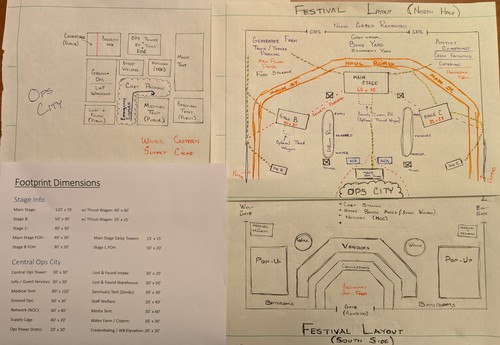
Feltware Festival is a traveling pop-up: a full festival city that gets built, lit, powered, and torn back down for a single 4 PM–4 AM push. Three main stages anchor the site, surrounded by defined zones for vendors, pop-ups, FOH pits, ground ops, medical, media, and a small forest of towers, cable runs, and crew compounds. On paper, it’s a very serious, very real 50,000-capacity layout—mapped down past generator farms, haul roads, and RF masts to the placement of trash cans. The whole thing is modular by necessity: touring structures, pre-rigged kits, labeled pallets, and systems designed to snap into place fast, because this city has to pack itself back into trucks and do it again.
In practice, it’s run entirely by puppets.
Twice a year, this felt-and-foam crew drags the operation from its “home” facility to a new site, rebuilds the maze, throws the switch, and does it all over again. It’s an objectively masochistic business model—high risk, brutal logistics, thin margins—but that’s part of the joke and part of the heart. The world treats the festival like a miracle; the crew treats it like another shift.
Each Bobku track drops into a single moment inside that world: one time stamp, one zone (main stage, open decks, ADA pit, ops city, concessions, etc.), and one point of view trying to keep the night from falling apart.
Did You Actually Plan This Festival?
Yes. Unfortunately. I have receipts.
I can’t ever do anything halfway, and the logistics became a brainworm: stage footprints, ops city, haul roads, med & security hubs, vendor lanes, FOH lines of sight, stage configuration changes, changeover buffers, holds, strike windows… the kind of stuff that disappears when it’s right and becomes a disaster when it’s wrong. The lore is silly. The planning is… annoyingly real. And once you can literally trace the audio bleed—Stage C spilling toward the East Gate Pop-Up—or see where Stage B has a 23-minute hold that had to become a changeover, you start to see how the site plan, the schedule, and the storytelling are the same organism. Maybe it was worth the effort. Probably not though.
And if you want the full spreadsheet-brain version…
It’s a single-page site plan with tiny labels—stages, ops city, roads, gates, and support zones. Zoom in and wander.
And because apparently drawing the site wasn’t enough, there are also stage-by-stage operational schedules.
The public festival runs 4 PM–4 AM, but the stage schedules show the production math around it: build, show-ready holds, configuration changes, changeovers, unallocated windows, safety buffers, and strike. They’re there for anyone who wants to check the timing, write a song into an open slot, or understand where the chaos has room to happen.
A World Inhabited by Puppets
The world of Feltware is fully inhabited by puppets—felt, foam, fleece, and whatever other materials are holding them together this year. There are no human characters on stage or backstage in the fiction; the entire festival ecosystem is run by puppets acting as DJs, producers, runners, riggers, techs, security, food vendors, ground ops, and everything in between.
The tone is whimsical, but the work is grounded in reality. Cables still tangle, routers still crash, cue stacks still misfire, and someone still has to clean up the trash at 03:30. The puppets may be soft, but the logistics are not.
Around the project, people sometimes call this aesthetic “Muppetcore” or “felt & metal” as shorthand for puppet-show charm layered on top of real-world festival mechanics. It’s a fan nickname, not an official brand or affiliation.
The 4pm–4am Window & Canon Rules
For now, the entire released discography is canonically set inside a single 4pm–4am edition of the Feltware Festival. Each song is anchored to:
- A rough festival time cue (for example, 16:03 or 01:45).
- A location (main stage, FOH pit, East Gate open decks, etc.).
- A perspective (performer, crew member, intern, or the festival itself speaking through the mix).
Tracks can jump perspectives and genres, but they all share the same physical space and the same one-night timeline. If you follow the timecodes in the song notes, you can walk through the festival in order—from first gates, to chaos in the middle, to the fragile sunrise reset.
The Bobku Collective In-Universe
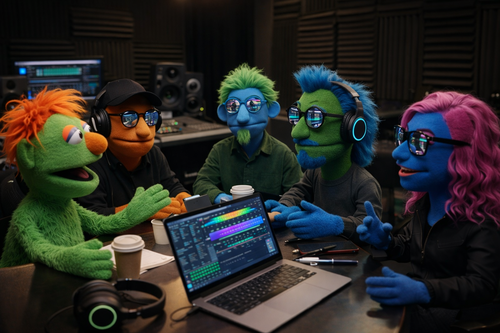
In-universe, the Bobku collective is a loose studio crew of puppet producers, engineers, and techs who orbit the Feltware Festival. They mix sets, design sound, troubleshoot signal chains, and sometimes step out onto the decks themselves.
Each track has a “Lead Producer”—the puppet who gets the captain’s chair for that release. Everyone contributes, but the lead chooses the scene, steers the genre, and has final call when decisions collide.
The Lead Producer Rule
The studio works like a rotating ship crew: every puppet gets a turn at the helm. When it’s your track, you pick the mission—what part of the festival we’re in, who we’re writing for, what the drop should feel like, and what kind of weirdness is allowed to live in the mix.
It’s a practical system disguised as lore. Rotating the lead keeps songs moving, prevents decision paralysis, and avoids hard feelings—because everyone knows their turn is coming, and every release still carries fingerprints from the whole room.
Practical note: on the song pages, only the Lead Producer is listed as the primary credit. Everyone else shown is part of the in-universe support crew for that release—from studio manager to intern.
Vocals follow the same logic: whoever owns the scene (or whoever grabs the mic) “performs” the track. Don’t worry about Dial’s singing. That’s what Melodyne was made for.
If you want to see who’s who behind the scenes, the Meet the Crew page breaks down each persona and their role in the studio ecosystem.
Themes & Tone
The core theme of the Feltware Festival is simple: this is music about making music and running a show.
The songs are allowed to be silly, heartfelt, technical, or all three at once, but they stay firmly grounded in what it actually takes to pull off an event of this magnitude. That includes:
- Respecting the labor and expertise of crews, interns, and night-shift heroes.
- Using technical terms and jargon correctly, even when it’s used for jokes.
- Keeping at least a thread of hope, kindness, or moral perspective under the noise.
- Never forgetting that at the end of the day, it all has to be danceable.
The inspiration is a show about making a show; Feltware is a festival about making a festival. You’re always a half-step backstage, even when the track is aimed at the crowd.
For Writers, Producers & Collaborators
If you’re using this world as a reference—for fan fiction, visual art, future tracks, or just to help an AI understand what’s going on—these guidelines keep things in-bounds:
- Stay inside the 4pm–4am window for current canon songs unless you’re intentionally exploring “between festivals” or pre/post timelines. For reference, two days to build, two days to strike. We’re not counting site prep, we’re not counting sponsor chaos, and we’re definitely not counting the part where everyone realizes—too late—that Beauregard promised it would ‘go faster this time.’
- Anchor each story or track to a location, time, and role (stage or zone, approximate time, and whose eyes we’re seeing through).
- Keep the world fully puppet-inhabited. The tone comes from treating puppet characters like real workers doing real jobs.
- Use technical language accurately. It’s okay to be funny, but it should still make sense to someone who’s worked a show or opened a DAW.
- Lean hopeful or constructive. The world can be stressful, messy, and chaotic, but the project tries to honor people more than it tears them down.
The songs themselves can mix perspectives: a verse from an FOH engineer, a chorus from the crowd, a bridge that sounds like the festival’s PA having feelings about all of it. As long as it respects the work and keeps the beat, it fits.
Future Stories: Between Festivals
Right now, the Feltware canon lives entirely in the space of one festival night. Future projects may explore:
- Load-in days, rehearsals, and technical runs leading up to the gates opening.
- What the crew and performers do in the weeks between festival editions.
- Side stories centered around specific stages, vendors, or recurring background characters.
- How the Bobku collective evolves from one year’s Feltware to the next.
As new songs release, this page will be updated to reflect where they sit in the world and how the festival grows around them.